

Tactics for Remembering
Memory, Material, and Heart


It’s the last week to experience Tactics for Remembering at MoCA Arlington!
This is the first exhibition I’ve ever curated (independently) for a museum, and its personal significance has continued to deepen over the time it’s been on view—especially amid an eventful 👀 start to 2026.
I’m grateful to share that the show was recently featured on Hyperallergic! It means the world to me to have our voices recognized, and to see such a respected platform paying attention to this work. As the exhibition comes to a close, I want to share a short essay I had written about it, but not previously published.
Tactics for Remembering emerged from an urgent desire to preserve the intangible: the emotional, embodied, and invisible inheritances we hold onto when the ground beneath our feet isn’t as solid as we once thought. In the face of forced migration, political rupture, and cultural erasure, this exhibition invites visitors to reflect on the notion of home as a fluid and emotional space—shaped by memory, the body, absence... It reflects on how we anchor ourselves to the world through the repetition of gestures, the intimacy and triggering nature of objects, and the spaces we try to recreate even when we are far from where we began.
Originally conceived as a platform for Venezuelan artists for the museum’s Global Spotlight series (which brings attention to a different country each year), the exhibition includes a Cuban artist, “bending the frame” of national boundaries toward an affective geography: Cuba-Zuela. This linguistic hybrid, often used pejoratively, is reclaimed through a sense of transnational solidarity, affirming historical and cultural kinships between these two nations bound by the Caribbean Sea. Both Cuba and Venezuela are marked by parallel and interrelated struggles, and linked by two sister diasporas. The Sea –a body that simultaneously connects and separates– becomes a symbolic axis in the exhibition, connecting people on “the other side of the water” and holding within its cyclical tides stories of power, migration, survival, and rebirth.
Cuba-Zuela is not just a geographic or political construct; but an emotional cartography. It signals a shared historic and diasporic condition. Through this grouping, the exhibit resists narrow nation-based curatorial models and instead honors the permeability of Caribbean identity, and the ties born from both inherited circumstances and lived experience.
The artworks in this exhibition consist of/feature materials with their own lived lives. They hold experiences, remember the past, and trigger our memories when we forget—I like to call them objects of embodied memories. These objects challenge what it means to be important and valuable; and they matter because of what we attach to them, even when formal history might overlook them, like a child’s shirt, or a plastic cup. They’re material witnesses to our lives and our losses, enduring when we eventually don’t. Whether in the immersive textile landscape sewn by Lisu Vega; in Amalia Caputo’s recorded action of pulling a house into the ocean; or in Reynier Leyva Novo’s meticulous sculptures of “nothingness”, there’s an intense dedication, physicality, and conflicting energies to these pieces, caught between emptiness and fullness, levity and gravity.
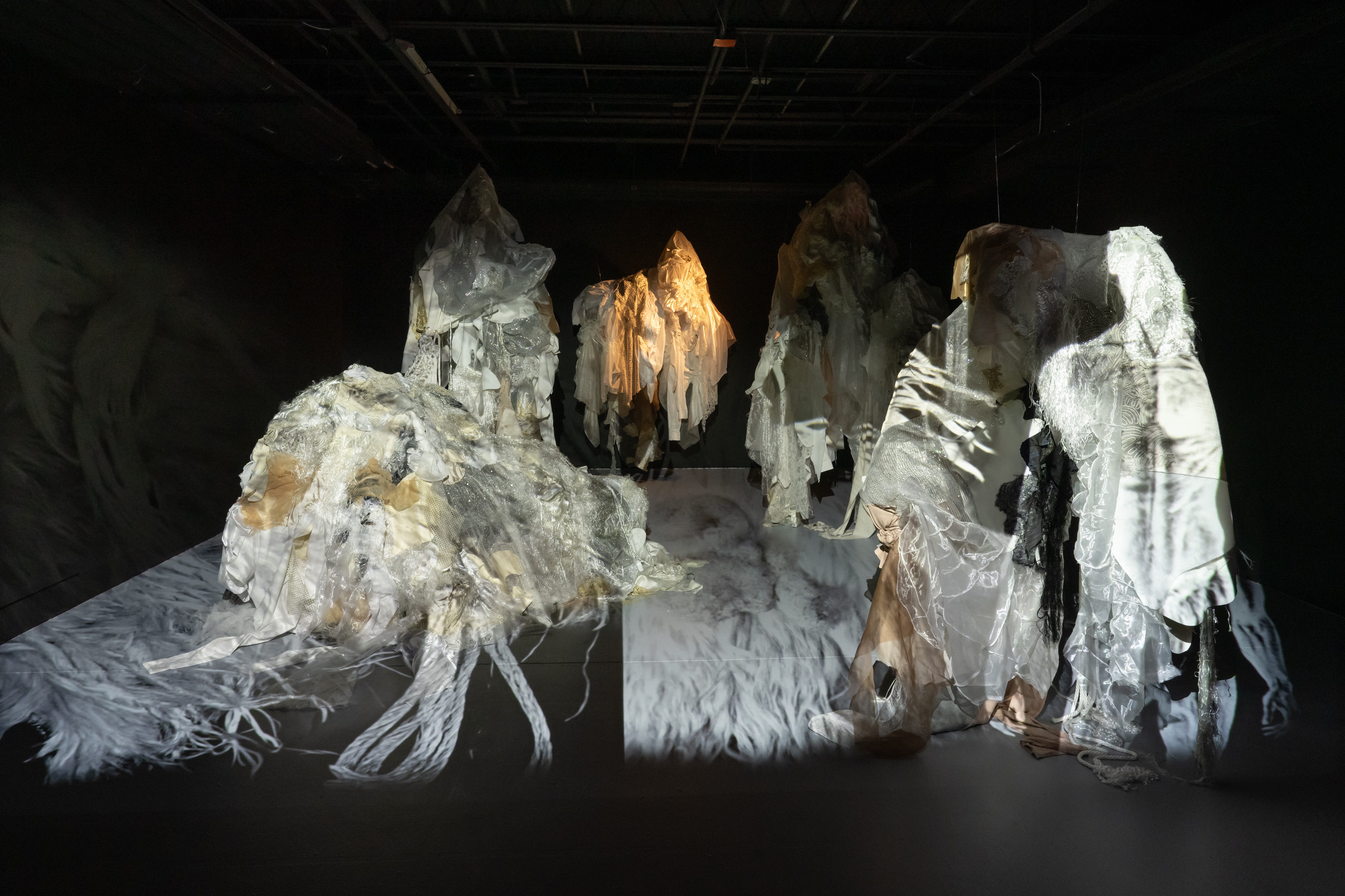
Vega’s penetrable installation, The Uncertain Future of Absence (El Futuro Incierto de la Ausencia), carries traces of her grandmother’s weaving techniques and channels her inherited memory. Her Wayúu background (one of many surviving Venezuelan Indigenous groups) holds a rich legacy of textile knowledge, where every thread functions as material and message, encoding stories of community, land, and survival. Large panels made of white and off-white fabric scraps are draped over organic structures, testifying to the lives she’s connected to through gifts, mementos, and garments she’s created. The work incorporates remnants of wedding dresses, her kid’s school uniform, embellishments brought from home, as well as remains of previous works—each fragment coming together to form a new whole.
Rust-printed photographic stories overlay the textiles, acting as both surface and filter, while a video projection drawn from Vega’s and her collaborator Carlos Pedreáñez’s photo archives show shifting scenes of familiar yet fractured recollections. This multi-sensory terrain is complete with a soundscape of Vega’s own poetry translated to Wayúunaiki, serving as a lyrical homage to the continuity of her ancestral lineage.
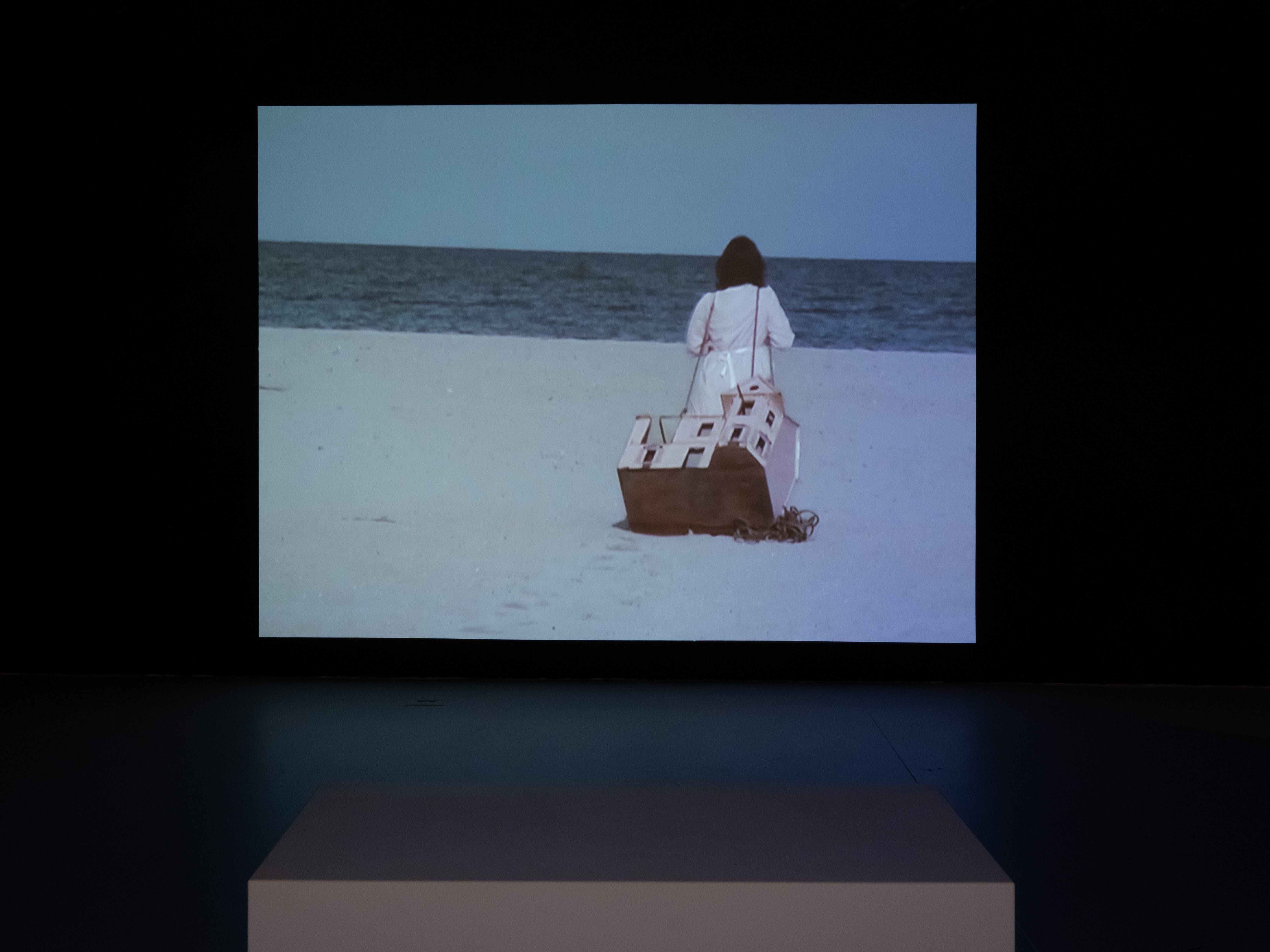
Drawing from the myth of Hestia, the Greek goddess of the hearth, Caputo reimagines feminine figures from world mythologies to challenge archetypes of womanhood and homemaking. In her video, La casa (de Hestia) [The House (Of Hestia)], a woman drags a small-scale house through the sand towards the ocean, conveying the gendered expectations of domestic labor. As the house reaches the water and begins to float, the act becomes both a meditation on home as provisional, mobile, and often, unbearably heavy, as well as a ritual of release, challenging the conventional image of women as custodians of the home. The drifting structure speaks to displacement and the impossibility of fully carrying one’s home across space, breaking gradually along the way.
The sea, witness to countless lives journeyed, coerced across, and lost within its depths, transforms the action into a layered metaphor: it demands home-keeping as a collective responsibility, not just a woman’s burden; the house may not just be floating away, but returning to its original place; perhaps it’s an offering of home to those who never made it across. Through movement, strain, and release, Caputo invites us to confront the physical and emotional toll of memory-keeping in exile.
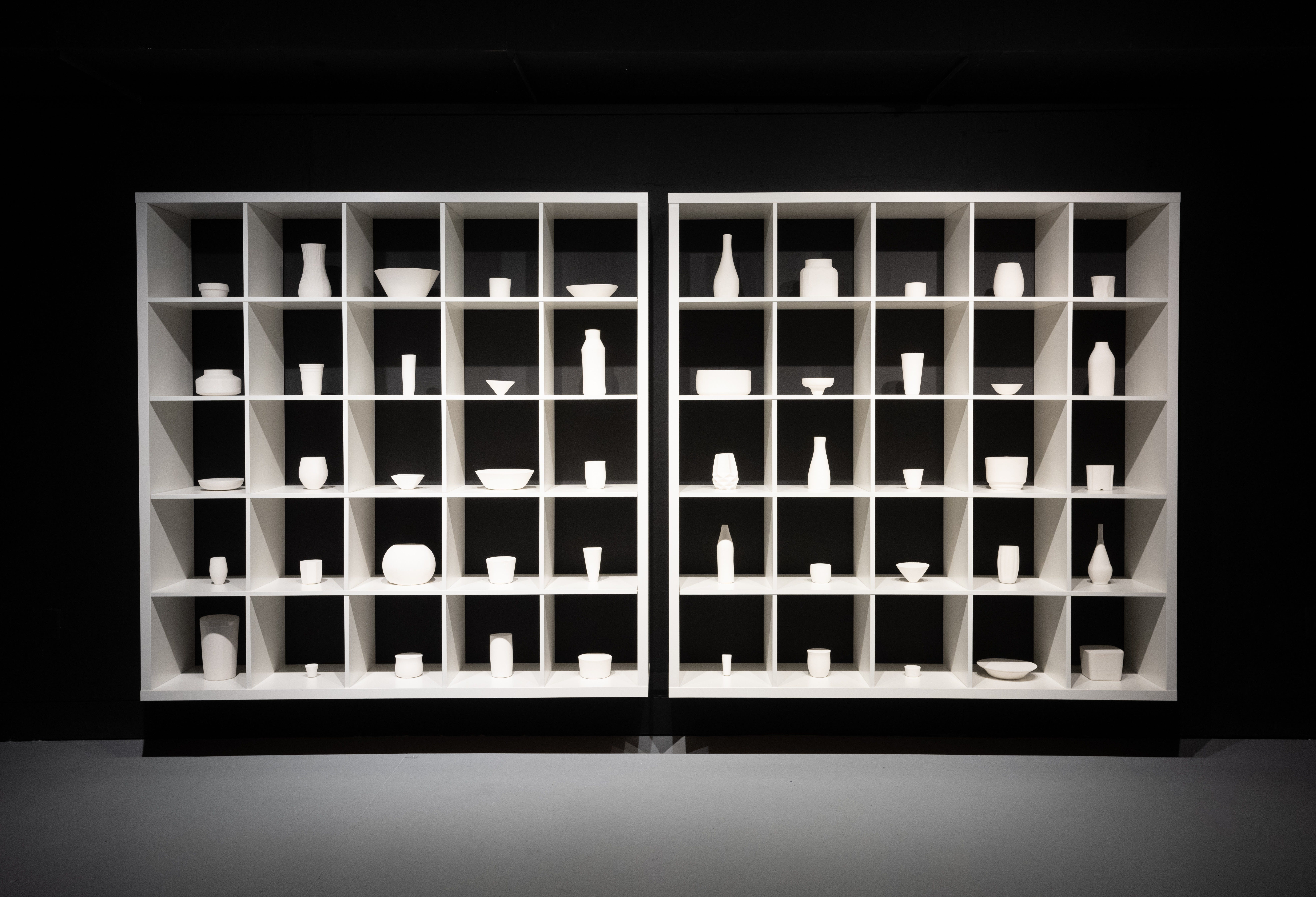
Novo’s Solid Void (#2) challenges our understanding of objecthood and permanence. After relocating from Cuba to the US, he was forced (like so many of us before, and after him) to leave behind much of his material life. What was invaluable became disposable, and everyday objects transformed into markers of history and presence. At first glance, his works look like replicas of vases, cups, bowls… but they’re in fact, their hollowness. Novo filled these forms with a specialized cement, then recovered the mass of their emptiness—the space that was meant to hold something. Many original objects were destroyed in the process: a deliberate response to the dynamics of construction, destruction, and reconstruction of memory.
By giving form to these absences, he transforms emptiness into a tangible, visible, weightable object (and they’re heavy!). One can imagine –and even calculate– the weight of all the things we’ve been forced to abandon; but the heaviness of abandonment itself, and the emptiness it leaves in you, is unmeasurable. These sculpted interiors of everyday vessels offer a poetic, ascetic articulation of substance, absence, and essence.
Together, the artists in Tactics for Remembering insist on building visual languages rooted in memory’s material and immaterial dimensions, sharing stories of what stays with us no matter what. Their works remember through representation and process: they’ve been touched, broken, molded, stitched, pulled, and held, rendering the tactics tactile, and revealing how the practice and pain of remembrance aren’t only mental or emotional, but profoundly physical.
I can’t thank the artists enough for bringing this vision to life! Every project I work on is deeply meaningful, but this one’s among the most transformative, personal, and heartfelt I’ve ever had the honor of being part of.
Brilliant! These works are incredibly moving in person, you can feel the artists, and their loved ones and things they left behind, in each one, in such a unique and beautiful ways. Congratulations on this show and thank you for sharing these amazing objects and artists with us!
This exhibition is such a beautiful, necessary meditation on memory, migration, and the emotional architectures of home. Huge congratulations, this kind of curatorial care and depth really shows. 🤍