

Wound Work
Rebecca Perez on her new trauma-informed art and literary journal


I was first introduced to Rebecca Perez while jurying an exhibition at Falls Church Arts; her Bata piece struck me immediately, pulling me back to memories of my grandma, great-grandma, aunties… tender and complicated ones. Later, I curated her work into the exhibition Between, Through, Across at the DC Arts Center. That’s how it usually goes: you see something that resonates, you reach out, you collaborate… then collaborate again. When the work is good, you come back.
So when she invited me to help build Tendrils Journal, a new, independent publication bringing together visual and literary artists, it was an easy yes. The idea of trauma and healing through the arts moved me deeply, because for many of us, art is the way we’ve learned to name, process, and tend to things within.
In this interview, I ask Rebecca why she chose to lead this project — one so personal to her, but still communal.
FRD: How has trauma and the process of healing shaped your own creative practice, and how did it influence the vision for Tendrils Journal?
RP: In hindsight, I see that trauma has always been a part of my creative practice, whether I understood it or not. But before I had the emotional tools to process my past, the work didn’t really dig too deep, and if it did, I quickly abandoned it. Finally going to therapy changed everything, personally and creatively. I got to a place where looking deeply at, and making art about, the “dark” unmentionable aspects of my life experiences was possible. I also started to become more involved in communities, through friendships, volunteer work, and spaces like DCAC and AIGA DC. I know firsthand the feeling of isolation trauma can bring. Isolation because of the idea that these experiences can’t be shared with anyone, or as a means of self-protection, or just a feeling that you’re marked “different” because of it. I knew the journal had to combat this by making community part of its ethos. It’s not only about the art. It’s about how the art becomes a path to conversations, community, and healing. Interestingly, I have found that producing Tendrils has freed up space in my practice to explore other things that are not so trauma-centered. It’s like I have more creative space now.
FRD: Why did you feel a journal (specifically one centering trauma and healing) was something the art community needed right now?
RP: I had no idea it was needed, but I know that I needed it. I’ve spent my entire adult life trying to make art and managing/living with/finding joy despite my past trauma. I have always found peace, beauty, and reflection in art and literature that explores life’s painful moments, but I would discover the work randomly and sporadically. The more comfortable I became exploring my past and emotions through my work, the more I searched for other artists doing the same. I longed to find them together, to have them “be” in the same space and in dialogue with each other, and me.
FRD: How do you balance the desire to engage deeply with painful experiences, while making sure the publication doesn’t accidentally re-traumatize readers?
RP: It’s challenging to foresee what might be cathartic or re-traumatizing for someone else, but that’s not a reason not to pay close attention. Proceed with caution and care, and always try to be aware of who might be on the receiving end. This is why the journal includes guidance from a licensed therapist. I wanted to be sure the reader had at least a small balm for what might come up. From a personal standpoint, sometimes the only way to differentiate is through trial and error. I’ve learned that there are some types of movies or books that I just can’t read or watch. And that’s ok. Be kind to yourself and meet you where you are.
FRD: What role do you hope Tendrils will play in our creative communities?
RP: I hope Tendrils will be a platform for artists, writers, and trauma survivors for creative expression, community, and healing. With the journal we’re not only making a space for conversations about trauma, but also helping promote and support creatives. I also want Tendrils to be an example and champion of the healing aspect of creative practice and engaging in the arts.
FRD: Each edition of Tendrils focuses on “Trauma and (something)”. First it was Trauma and the Body, now it’s Trauma and the Environment. What excites you the most about this second edition?
RP: What excites me is the variety of art and writing that we’ll get to experience. Working on the premiere edition showed me how diverse in source material, mediums, and points of view this topic can include. I was surprised and inspired by the work submitted. So I’m excited to see all the different points of view and interpretations on this new theme. I know there will be some that I can’t even imagine, but will make perfect sense once I see or read them.
FRD: Can you share a moment during the journal’s development process that felt like a breakthrough to you?
RP: The journal has developed very organically, so I’m not sure if there have been any big breakthroughs. For me, the breakthrough was the journal itself. I’ve worked as an art director and designer for over 20 years. For years, I’ve wanted to produce a zine or publication about a social issue and played around with different ideas, but I never really made any progress. Once I honed in on the concept of trauma, everything clicked. It feels like I took one step onto an invisible bridge, and the path emerged.
FRD: What have you learned about yourself while building this journal?
RP: Building Tendrils has really pushed me professionally. Taking on the role of “publisher” is a very new experience, and I continue to learn as I go. I’ve often thought of myself as more comfortable in a background role, support staff, etc., but this work requires me to stand in front. I’ve led teams and big projects before, so it’s not completely new, but because it’s my concept and so personal, it means I can (and need to) bring my full self to the role.
FRD: What are some of your dream collaborations for future issues?
RP: First, I want to acknowledge our collaboration. Your expertise and talent have helped make this possible, so thank you! Since every edition focuses on a specific topic, it would be wonderful from an editorial standpoint, as well as a learning experience, to collaborate with someone who works in that space. For instance, if we produce an edition on the prison system, we might include a guest essay by someone who has worked with and advocated in prisons. Also, working with a research lab or nonprofit focused on arts and health would be very exciting. There are many doing interesting work on the health benefits of the arts, and I think it’s a natural fit. A current collaboration that I’m excited about is working with a different designer every year to creatively interpret our values, “community, creativity, and empathy,” into design for swag. In 2025, Raksa Yin (Instagram: @_raksa, URL:raksayin.com) designed our first t-shirt, which we love. We’re launching a new design in January 2026, so stay tuned.
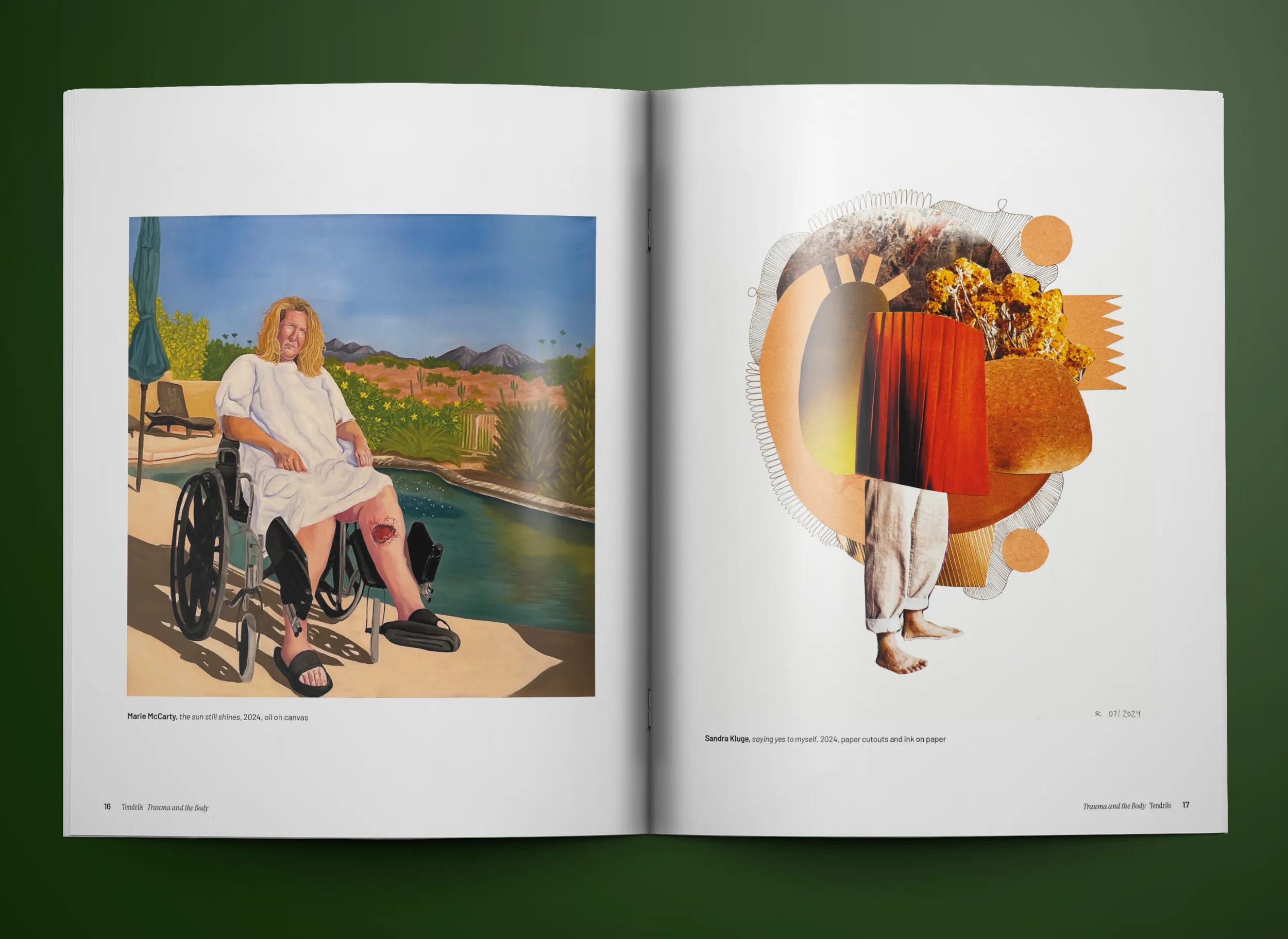
Tendrils Journal is a shared space for artists to work through difficult experiences, where personal pains converge and are felt alongside each other. You can purchase the premiere edition, Trauma and the Body, on the website: tendrilsjournal.com.
Submissions are OPEN for the second edition, Trauma and the Environment, until November 30.
When the brush touches the wound, what heals first—memory or image?